The EU-funded TIGON project has developed software and hardware solutions the rollout of DC microgrids

5

years

15

partners

8

countries

4

showcases

Context

Clean local energy and modern electrical equipment run on direct current (DC)

Most electricity grid infrastructure remains centralised and uses alternating current (AC)

Conversion from DC to AC and back to DC leads to power losses, which add to the losses due to long distance electricity transmission.

  • multiple conversion stages reduce efficiency and reliability of power systems
  • the low technology readiness levels of DC technology means
  • DC technologies lack standardisation
  • AC-DC grid interconnection requires extra effort
  • digital infrastructures may be vulnerable to cyberattacks
Challenges

If DC grids are to offer a promising and commercially viable solution in the energy transition, the technological and regulatory bottlenecks need to be removed.

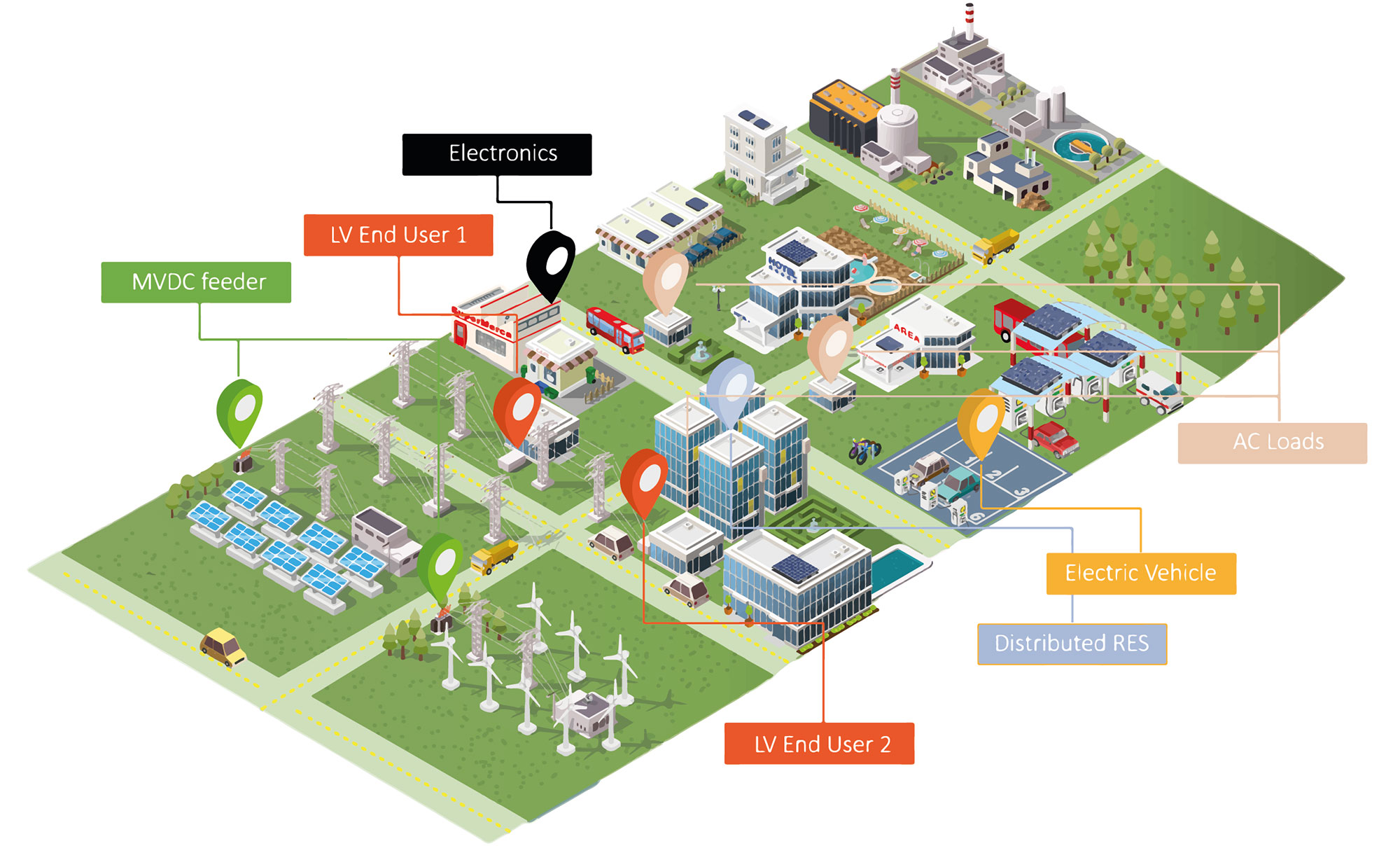
The challenge for integrating more renewable energy and DC loads is to seamlessly integrate DC grid into the main electricity network while ensuring resiliency and cost-effectiveness.

5

Years

15

Partners

8

Countries

4

Showcases

Solutions

  • Pioneer modular DC microgrids

    to help the European Union’s electricity grids become greener, more efficient and more resilient

  • Flexible software and hardware solutions

    demonstrated on two medium to low voltage microgrids in France and Spain

  • Decision-support system

    for planning grid expansions and new hybrid grids across the EU

Once we’ve obtained results and mapped the features of TIGON’s solutions, we’ll apply them to 2 use cases – one in a DC district in Finland and the other, a metro line in Bulgaria.
They will act as niche markets for analysing microgrid rollout and replicability.

Our key objectives

Reliability

Reliability

Resilience

Resilience

Performance

Performance

Cost

Cost efficiency

  • Decision support to help grid operators shift to decentralised hybrid microgrids
  • Higher resilience of electricity grids to faults and cyberattacks
  • Greater share of renewable energy sources in the power network
  • Increased efficiency through the grid architecture
  • Contribution to policy and standards
  • Technology readiness levels to rise from 5 to 7 and 8

Impacts

  • More efficient energy systems

  • Less cumbersome infrastructure

  • Battery storage systems and peak saving and time shifting

    potentially by 10%

  • Greater share of renewable energy

    potentially 25% energy efficient

Media kit

Discover and download TIGON’s graphic materials.

Download the media kit ↓

Fellow projects

SINNOGENES

SINNOGENES project aims to develop the Storage INNOvations (SINNO) energy toolkit, a complete framework of methodologies, tools and technologies that will enable the grid integration of innovative storage solutions beyond the state-of-the art, while demonstrating sustainability, technical performance, lifetime, non-dependency on location geographical particularities and cost.

eFORT

Making European power grids more resilient and secure

eFORT makes European power grids more resilient and reliable against failures, cyberattacks, physical disturbances and data privacy issues. eFORT will increase power system stability by developing technologies for identifying, preventing, and mitigating risks and vulnerabilities.

SSTAR

Innovative solutions to improve energy power sector performance

SSTAR aims at promoting solid-state transformer technology, increasing operational voltage level and enlarging its application within the energy power sector

Theus

THEUS aims to showcase advanced methodologies and tools supporting hybrid grids implementation across High Voltage (HV), Medium Voltage (MV), and Low Voltage (LV) levels. The effectiveness of these solutions will be substantiated by their validation in five use cases building on data from five real planned and operational networks. By fostering collaboration with key actors, the project aims to achieve TRL 5 by its conclusion.

NEWGEN

New Generation of HVDC Insulation Materials, Cables and Systems

NEWGEN aims to develop and proof new insulation materials, manufacturing solutions, online condition monitoring, and comprehensive life and reliability modelling tools for next-generation of extruded HVDC cables and cable systems, thus fostering the reliability and resilience of the European HVAC/-DC transmission grid.

HYPERRIDE

DC /AC-DC hybrid grids for a modular, resilent and high RES share grid development

It will contribute to the field implementation of DC and hybrid AC-DC grids by identifying and providing solutions to overcome barriers for a successful roll-out of new infrastructure concepts throughout Europe.